What 'Non-Nano' Zinc Actually Means
Decoding the particle-size marketing.
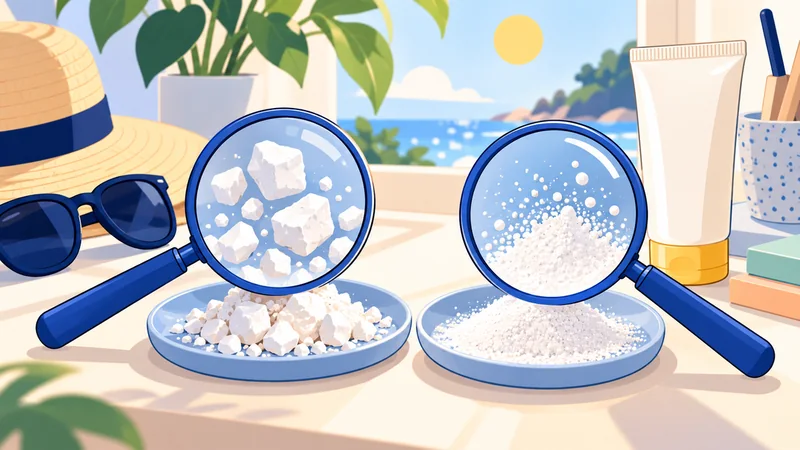
Zinc and titanium agglomerates roughly 0.1–10 micrometers across scatter visible light, which is what produces the white cast; non-nano simply means the particles are above the ~100 nm nano threshold.
White cast comes from larger zinc and titanium particles scattering visible light, so 'non-nano' formulas tend to leave more cast than well-dispersed nano ones.
Questions we get a lot
What does 'non-nano' zinc oxide actually mean?
'Non-nano' means the zinc oxide particles are larger than about 100 nanometers, the regulatory cutoff for a nanomaterial. Larger particles scatter more visible light, so non-nano formulas tend to leave more white cast, while smaller nano particles rub in more clearly.
Is non-nano zinc safer than nano zinc?
Current evidence indicates that nanoparticles in sunscreen don't penetrate healthy, intact skin, so nano zinc is considered safe to use. People often choose non-nano for environmental or personal-preference reasons rather than a proven safety advantage — the main practical trade-off is more white cast.
Why does mineral sunscreen leave a white cast?
White cast comes from mineral filters — zinc oxide and titanium dioxide — scattering visible light, not just UV. Larger (non-nano) particles and higher concentrations scatter more, leaving a whitish film, especially on deeper skin tones. Tinted formulas with iron oxides, or well-dispersed/nano particles, reduce it.
r/SkincareAddiction: 'What does non-nano zinc oxide actually mean, and is it safer?'