Why 'Chemical-Free Sunscreen' Is a Marketing Myth
Everything is chemistry — here's what the label means.
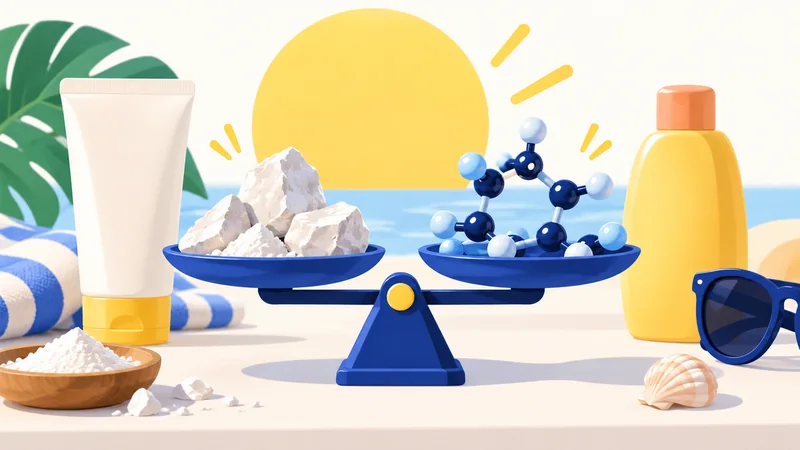
Both mineral filters (zinc oxide, titanium dioxide) and organic filters (such as avobenzone) are chemicals; the meaningful distinction is mineral versus organic, not 'chemical' versus 'chemical-free.'
Chemists point out that 'chemical-free' is impossible — zinc oxide is itself a chemical compound — so the term tells you nothing useful about whether a sunscreen is safe or effective.
Questions we get a lot
What does 'chemical-free sunscreen' actually mean?
Nothing scientifically — it's a marketing phrase. Every sunscreen is made of chemicals, including mineral ones: zinc oxide and titanium dioxide are chemical compounds. The honest distinction is between mineral (physical) filters and organic (carbon-based) filters, both of which are chemicals.
What is the real difference between mineral and chemical sunscreen?
Mineral filters (zinc oxide, titanium dioxide) sit largely on the skin and mainly absorb UV while scattering some; organic filters such as avobenzone absorb UV and release it as a little heat. Both reduce how much UV reaches living skin cells. Neither is inherently safer — choose what you'll wear daily.
Is mineral sunscreen safer than chemical sunscreen?
Major dermatology groups consider both well-studied and effective. Mineral formulas are often suggested for sensitive skin because they're less likely to irritate, but that's about tolerance, not toxicity. The most important factor is using any broad-spectrum SPF 30+ consistently and generously.
r/SkincareAddiction: 'Is mineral sunscreen actually safer than chemical, or is that just marketing?'