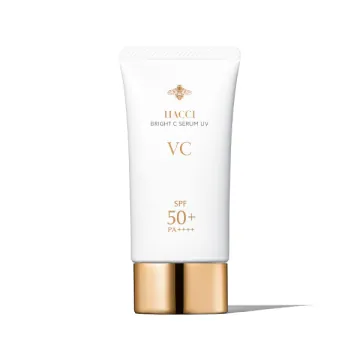
HACCI
Bright C Serum UV / SPF50+ / PA++++ / 50g
ブライトC セラム UV / SPF50+ / PA++++ / 50g SPF 50+ · PA++++ Tone-up Brightening veil from mineral & tone-up formulas; evens out your skin tone. Japan jp-domestic Formulation variant: jp-domestic. Region-specific reformulations are tracked as separate products.
Same formula as English-label HACCI; ethanol, fragrance, bee derivatives, octinoxate drive identical conservative scoring.
◉ HYB Hybrid filters Hybrid filters — Mineral + chemical filters together for the best of both. ((· BS Broad spectrum Broad spectrum — Blocks UVA + UVB — covers the whole sun-damage spectrum.
Where to buy it
Cosme.com JP In stock 広告 / Affiliate Disclosure · Sunscreen Ranker earns commission on the above links. Rankings are scored independently — no brand pays for placement.
66.0
Composite
Composite score · independent
Ranks #1105 of 1558 in the current catalogue. Same formula as English-label HACCI; ethanol, fragrance, bee derivatives, octinoxate drive identical conservative scoring.
01 The score breakdown
02 Composition · key UV filters 4 filters resolved
03 The facts, at a glance
Protection
Filter type Mineral filters (zinc oxide, titanium dioxide) sit on skin and reflect UV. Chemical filters absorb UV. Hybrid runs both.
Hybrid
Broad spectrum Covers both UVA and UVB. UVA drives aging and deeper damage; UVB gives you burns.
Yes
Formulation & feel
Texture How it feels going on — milk, gel, cream, spray, stick, essence, lotion, powder, or cushion.
Essence
Finish How it looks once dry: matte, natural, dewy, or glowy.
Natural
Tinted Adds sheer pigment (iron oxides) that masks the white cast common to mineral filters and gives a skin-tone finish.
No
Fragrance-free No synthetic perfume added. Not FDA-defined in the US; the EU requires 'Parfum' + the 26 named allergens on the label. 'Unscented' is different — it can hide masking fragrance. Botanical oils still scent.
No
Alcohol-free No drying short-chain alcohols (alcohol denat., SD alcohol, ethanol). Doesn't mean fatty alcohols like cetyl or stearyl — those are emollients.
No
Verdict Is it worth it?
Hybrid SPF 50+ pairing zinc oxide with octinoxate, bemotrizinol, and DHHB, plus ascorbyl glucoside, 3-O-ethyl ascorbic acid, ceramides, and royal jelly. The texture reads refined; ethanol, added fragrance, and octinoxate are drawbacks.
Pros
- Modern UVA filters: bemotrizinol and DHHB
- Layered vitamin C including ascorbyl glucoside
- Ceramide NG, NP, and AP for barrier
- Sodium hyaluronate crosspolymer and royal jelly
Cons
- Octinoxate is flagged for endocrine concerns
- Added fragrance increases sensitivity risk
- Ethanol-forward base can dry reactive skin
- Heavy active load widens allergen exposure
Who it's for: Buyers seeking a vitamin C-rich hybrid SPF essence who accept octinoxate, ethanol, and fragrance for the polished feel.
04 Full ingredient list (INCI) 50 ingredients
MODERN FILTER 2 LEGACY FILTER 1 MINERAL FILTER 1 ADDED FRAGRANCE 1 NATURAL FRAGRANCE 0 ALCOHOL 1 WATCH 0 ACTIVE 5
Aqua· Zinc Oxide Mineral UV filter — physical block; reef-safer. ·Cyclopentasiloxane·Mel· Alcohol Drying short-chain alcohol — can compromise the skin barrier and disturb the film if used in high amounts. · Ethylhexyl Methoxycinnamate Octinoxate — endocrine-disruption literature. ·Hydrogenated Polyisobutene·Butylene Glycol· Glycerin Humectant — the workhorse hydrator. · Diethylamino Hydroxybenzoyl Hexyl Benzoate Uvinul A Plus — modern photostable UVA filter. · Bis-Ethylhexyloxyphenol Methoxyphenyl Triazine Tinosorb S — broad-spectrum, very photostable. ·Ascorbyl Glucoside·Myristyl 3-Glyceryl Ascorbate·3-O-ethyl Ascorbic Acid·Lauryl Glyceryl Ascorbate·Bis-glyceryl Ascorbate·Ascorbic Acid·Gluconobacter/Honey Ferment Filtrate·Royal Jelly·Propolis Extract· Ceramide Ng Skin-barrier lipid. · Ceramide Np Skin-barrier lipid. · Ceramide Ap Skin-barrier lipid. ·Potassium Cocoyl Hydrolyzed Collagen· Sodium Hyaluronate Crosspolymer Hyaluronic acid — humectant. ·Fullerene·Pinus Pinaster Bark Extract·10-Hydroxydecanoic Acid·Sebacic Acid·Vaccinium Myrtillus Leaf Extract·Silica·Isononyl Isononanoate·Pentylene Glycol·Sodium Acrylate/Sodium Acryloyldimethyl Taurate Copolymer·Polyhydroxystearic Acid·Sodium Methyl Stearoyl Taurate·Isostearic Acid·Batyl Alcohol·Isohexadecane·Phenoxyethanol·Xanthan Gum·Polysorbate 80·Sodium Stearoyl Lactylate·Phytosteryl Isostearate·Hydroxyacetophenone·1‚10-Decanediol·Pvp·Polyglyceryl-10 Pentastearate·Behenyl Alcohol· Fragrance Synthetic fragrance blend — a common irritant. Composition is a trade secret; can include dozens of compounds. Avoid if your skin is reactive.
Source: brand-published INCI. Last verified 2026. Show in detail
05 Alcohol ALCOHOL Drying short-chain alcohol — can compromise the skin barrier and disturb the film if used in high amounts.
10 Diethylamino Hydroxybenzoyl Hexyl Benzoate MODERN FILTER Uvinul A Plus — modern photostable UVA filter.
11 Bis-Ethylhexyloxyphenol Methoxyphenyl Triazine MODERN FILTER Tinosorb S — broad-spectrum, very photostable.
34 Sodium Acrylate/Sodium Acryloyldimethyl Taurate Copolymer Sodium Acrylate/Sodium Acryloyldimethyl Taurate Copolymer
50 Fragrance ADDED FRAGRANCE Synthetic fragrance blend — a common irritant. Composition is a trade secret; can include dozens of compounds. Avoid if your skin is reactive.